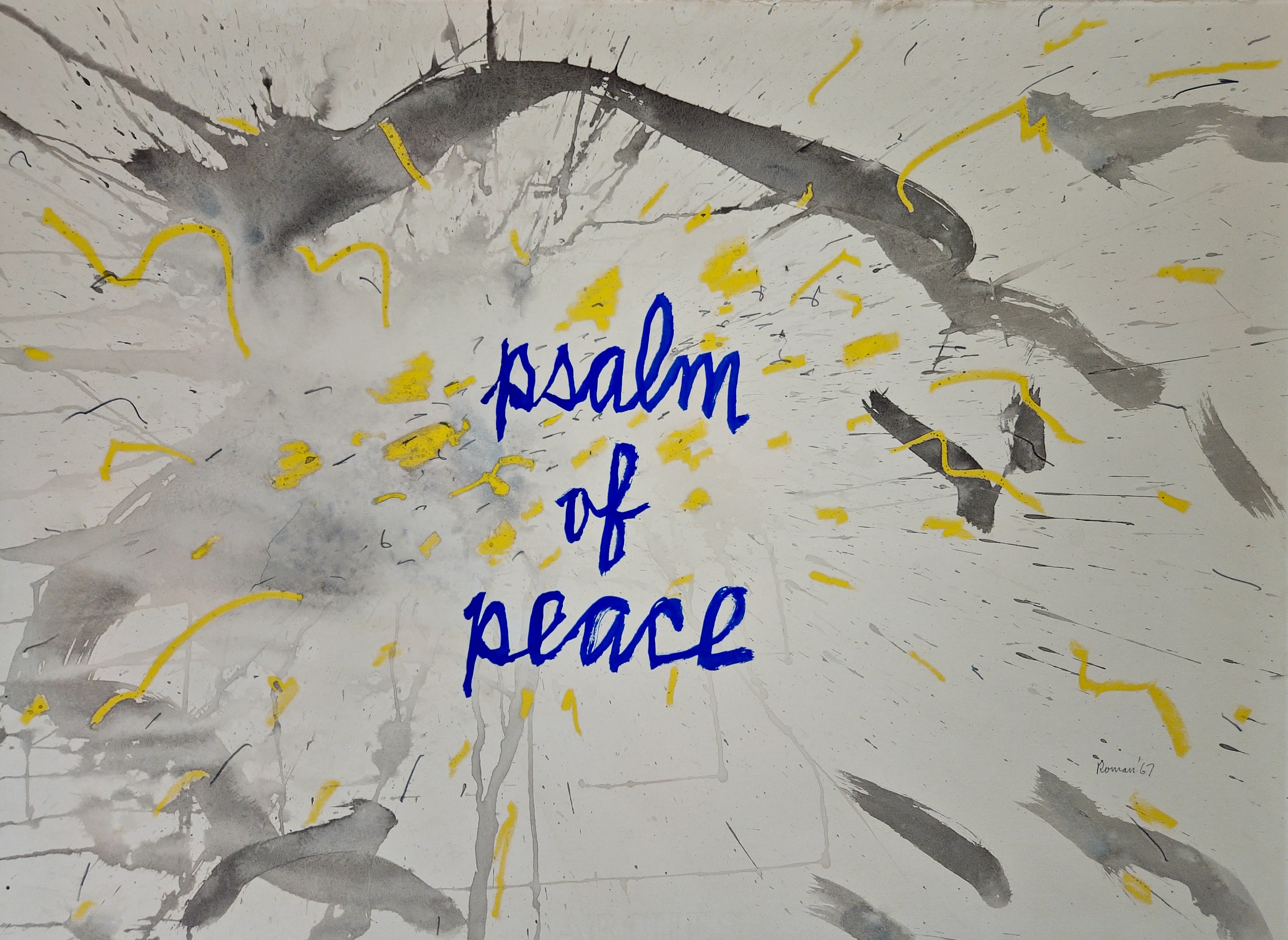
Psalm of Peace
A 1967 painting by Roman Verostko, predating his pioneering work in algorithmic art; from his pre-computer period of contemplative, scripturally-inspired abstraction.
- Medium
- Watercolor Painting
- Dimensions
- 30"x22"
- Edition
- Unique
- Provenance
- Available upon request
- Price
- $14,500
- Catalog №
- RO-010
Psalm of Peace, executed in 1967, belongs to the last full year of the monastic life of Roman Verostko (1929-2024), more than a decade before the artist built the custom software and pen-plotter rig that would make him a founding figure of algorithmic art. The painting was conceived as part of Psalms in Sound and Image, an electronically synchronized audio-visual program of projected images and tape that Verostko began at Saint Vincent Archabbey in Latrobe, Pennsylvania, and toured to more than twenty venues between 1967 and 1968, including Marymount Manhattan College, Yale Disciple's House, Duquesne University, Fisk, and Loyola Chicago. To encounter the work now is to see the contemplative grammar of the later Hodos software in its painted source.
By the date of this work, Verostko had already trained well outside the cloister. He took his MFA at Pratt in 1961, studied art history at Columbia and NYU in 1961-62, and spent 1962-63 at Stanley William Hayter's Atelier 17 in Paris. He returned to Saint Vincent, joined the seminary faculty in 1963, and continued painting in a studio he kept on the monastery grounds. The Psalms cycle was the culmination of that studio period. Verostko later described the series as an attempt to "magnify the 'marvelous' mystery of commonplace experience." A January 1968 lecture tour with the Psalms was followed by his decision to leave the monastery that summer, marry Alice Wagstaff, and accept the appointment to the humanities faculty at the Minneapolis College of Art and Design where he would teach for twenty-six years.
The pre-algorist paintings are scarce on the market. The bulk of surviving 1960s material is held at the Verostko Center for the Arts at Saint Vincent College, which retains the largest single concentration of his work. The Victoria and Albert Museum in London, ZKM Karlsruhe, and the Whitney Museum of American Art hold his later pen-plotter drawings; the painted Psalms have rarely surfaced outside institutional context. Christiane Paul, Grant D. Taylor, and Bruce Wands contributed scholarship to the 2019 MCAD retrospective Roman Verostko and the Cloud of Unknowing, which positioned the early religious abstraction as the conceptual beginnings for the code-driven practice; the SIGGRAPH Distinguished Artist Award of 2009 and his induction into the inaugural SIGGRAPH Academy in 2018 confirmed the same lineage from the institutional side.
In 1970, two years after Psalm of Peace traveled with the audio-visual program, Verostko spent the summer at MIT's Center for Advanced Visual Studies on a Bush Fellowship and took a programming course at the Control Data Institute in Minneapolis. Over the following decade he converted his studio into what he called an "electronic scriptorium"; his Magic Hand of Chance software was running by 1982 and the Hodos software by 1986, and his co-founding of the Algorists with Jean-Pierre Hébert in 1995 brought formal definition to a lineage of algorithmic practice whose earlier pioneers included Harold Cohen, Manfred Mohr, Vera Molnár, Frieder Nake, and Hans Dehlinger. A painting from the Psalms cycle documents the iconography, contemplative pacing, and scriptural address that Verostko spent the next half-century exploring with pen-plotter algorithms.