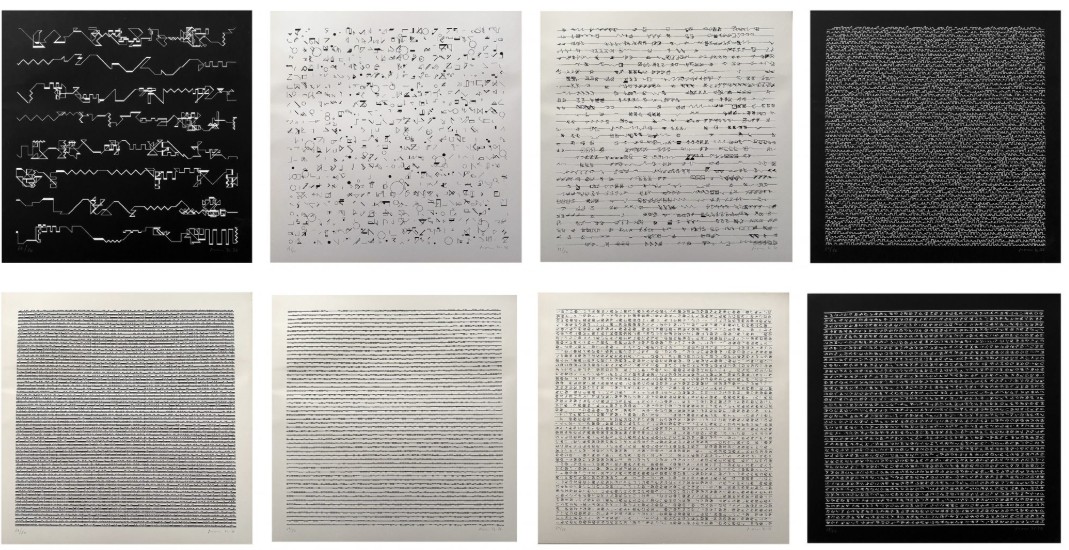
Scratch Code Portfolio
A 1976 portfolio by Manfred Mohr, the German-American algorithmic artist whose disciplined investigation of generative geometry made him a foundational figure of computer art.
- Medium
- Portfolio of 8 screenprints after plotter drawings, each signed and dated
- Dimensions
- 15.75 x 15.75 in
- Edition
- #32/80
- Provenance
- Galerie Gilles Gheerbrant, Montréal
- Price
- $17,500
- Catalog №
- RO-002
Scratch Code is a portfolio of eight black-and-white screenprints after pen-plotter drawings, edition of 80, published by Éditions Média (Neuchâtel) in 1976. The plates reproduce a sequence of Manfred Mohr's early text-based algorithms, programs written between 1969 and 1975, among them P-021, P-049, P-122, and P-155. The portfolio is one of the earliest editions to translate algorithmic output into a collectible printed object, and it formalised, in publishable form, the working method Mohr had introduced to a museum audience five years earlier.
Mohr (b. Pforzheim, 1938) trained as a lithographer at the École des Beaux-Arts and worked through the 1960s in Paris as a jazz musician and action painter before turning to the computer in 1969. His conversion is generally traced to his reading of Max Bense, whose information aesthetics, developed at Stuttgart through the 1960s, proposed that the artwork could be specified as a formal system. Frieder Nake, Georg Nees, and Mohr are the three artists most consistently identified with the practical extension of Bense's program into computer graphics. In May 1971 Mohr opened "Une Esthétique Programmée" at ARC, Musée d'Art Moderne de la Ville de Paris, recognised as the first solo museum exhibition anywhere of works calculated and drawn entirely by a digital computer.
The Scratch Code prints record the working vocabulary of that first period: dense fields of signs, ciphers, and short linear figures arranged by programs that incorporated controlled randomisation. Mohr has described the project as a "visual music," and could not predict the appearance of any given image until the plotter had finished executing the code. The portfolio therefore documents the central proposition Mohr shared with Nake and Nees, that authorship sits in the program rather than in the gesture, and that the plotter is an executor of decisions already specified in software.
Institutional holdings of Mohr's 1970s production are extensive. The Victoria and Albert Museum holds a complete Scratch Code portfolio (E.977:1-11-2008), the gift of the American Friends of the V&A through Patric Prince. Mohr is represented at the Centre Pompidou, ZKM Karlsruhe, the Stedelijk Museum, Kunstmuseum Stuttgart, the Ludwig Museum, and the Whitney Museum of American Art, which included P-021-U (Band Structures, 1970-1983) in the 2018-19 survey "Programmed: Rules, Codes, and Choreographies in Art, 1965-2018."
The present example is offered as a complete portfolio with folder, title page, text page, and the eight screenprints intact. Note the works show yellowing as appropriate with age and light scratching on prints with black backgrounds. The folder shows moderate discoloration. Inquire for detailed images.