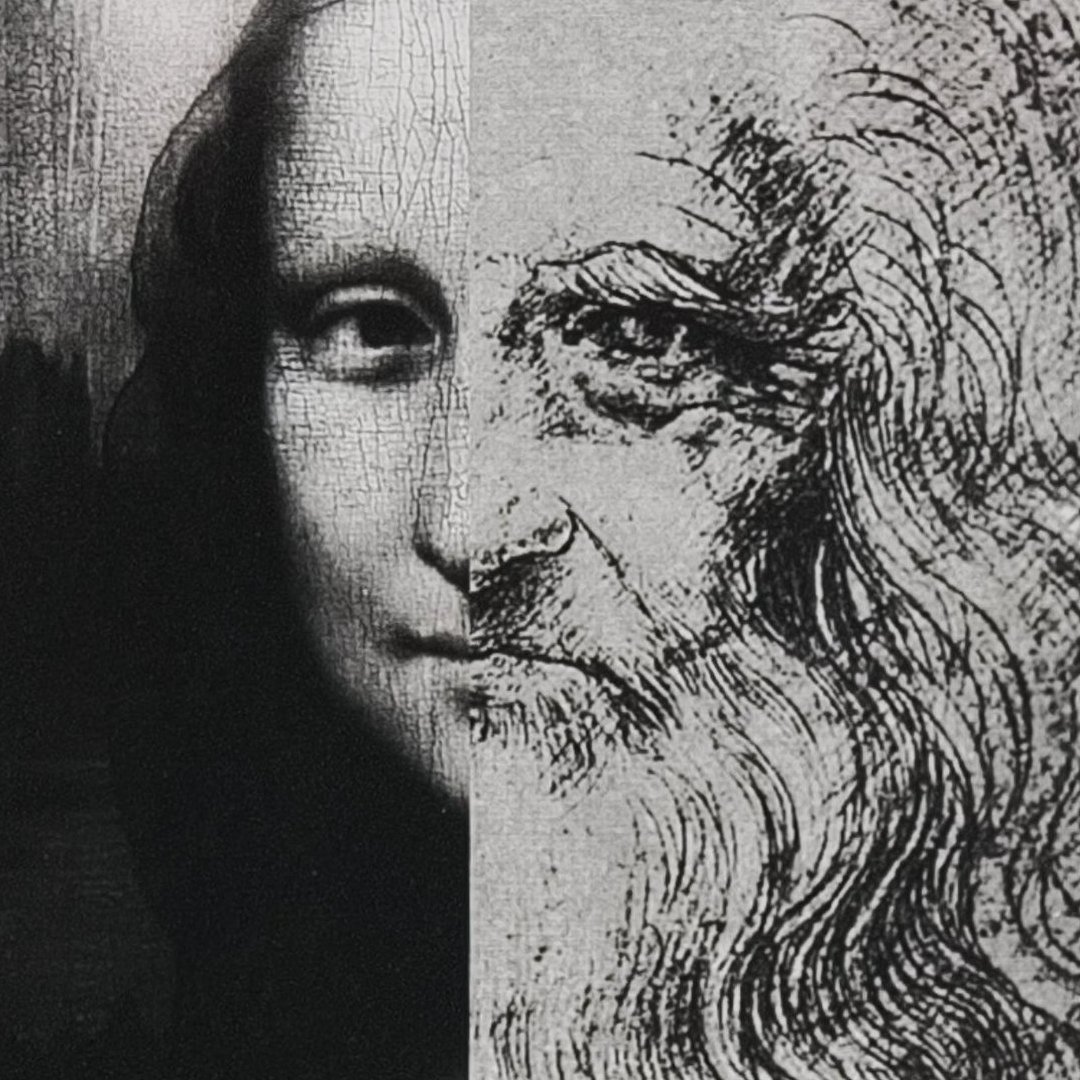
Mona/Leo
Schwartz's celebrated study superimposing Leonardo's self-portrait over the Mona Lisa. An art-historical claim and work of art.
- Medium
- Computer-composited photographic print on archival paper; produced at Bell Laboratories
- Dimensions
- 8"x10"
- Edition
- AP (edition of 20+AP)
- Provenance
- Available on request
- Price
- $17,500
- Catalog №
- RO-004
Mona/Leo is Lillian Schwartz's 1987 computer composite arguing that Leonardo's Mona Lisa is in part a cryptic self-portrait. Working at Bell Laboratories with computer scientist Gerard J. Holzmann's PICO image-processing program, Schwartz scanned the red-chalk drawing in Turin long believed to be Leonardo's self-portrait, mirrored its left half, and aligned it to the right half of the Mona Lisa. The eyes, brows, nose, and lips registered in close alignment. The composite, and the underlying argument, appeared as the cover story of Art & Antiques in January 1987, and the image entered general circulation through Scientific American (1995), Omni (1990), The Visual Computer (1988), and a segment on the CBS Evening News.
Schwartz had been a Resident Visitor at Bell Labs since 1969, brought in by Leon Harmon after her kinetic sculpture Proxima Centauri was selected for The Museum of Modern Art's 1968 exhibition "The Machine as Seen at the End of the Mechanical Age." Her tenure there ran thirty-three years, until 2002, and produced the founding canon of computer animation, many in partnership with Ken Knowlton: Pixillation (1970), Olympiad (1971), UFOs (1971), Enigma, Googolplex, and Apotheosis. Mona/Leo belongs to the second phase of that work, in which Schwartz turned the same computational apparatus on the art-historical archive itself, treating the digital composite as a tool of attribution. Arno Penzias, the Nobel laureate who oversaw research at Bell Labs, called her "a pioneer in establishing computers as a valid and fruitful artistic medium."
The Mona/Leo image is among the most reproduced single works of twentieth-century computer art, anthologized in The Computer Artist's Handbook (W. W. Norton, 1992), which Schwartz coauthored with Laurens R. Schwartz, and reprinted in surveys of digital art, art-history primers, and Leonardo scholarship for nearly four decades. Schwartz's films and prints are held by The Museum of Modern Art, The Metropolitan Museum of Art, the Whitney Museum of American Art, the Centre Pompidou, the Stedelijk Museum, and Moderna Museet, Stockholm. She was included in ZKM Karlsruhe's Algorithmic Revolution (2004) and bit international. [Nove] tendencije (2008-2009), and had her New York solo debut at Magenta Plains in 2016. Her papers, films, and studio archive were transferred to The Henry Ford in 2021, where the Mona/Leo composite is held.
The present sheet is an AP from a small edition produced on archival paper from the original Bell Labs PICO output files. Schwartz died at her home in Manhattan on October 12, 2024, at ninety-seven, and obituaries in The New York Times, ARTnews, and Artforum framed Mona/Leo as the work that brought computational image analysis into the mainstream art-historical conversation. Studio prints from this production sequence are nonexistent on the market; institutional holdings account for the great majority of impressions.