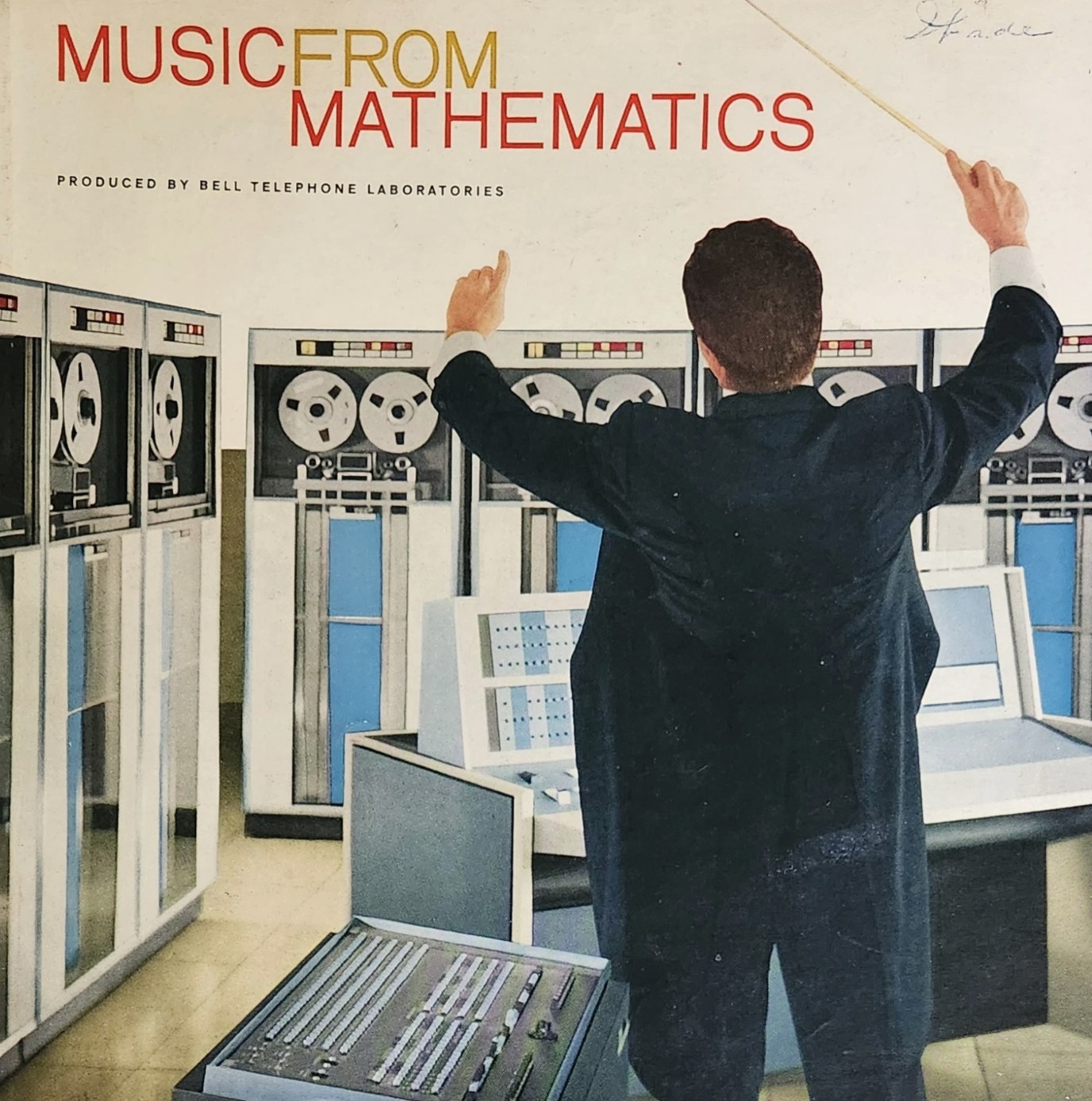
Music from Mathematics
The original 1960/1961 Bell Telephone Laboratories box set — a small private release documenting the first generation of computer-generated music, recorded on the IBM 7090.
- Medium
- Long-playing record box set, original 1960/1961 Bell Telephone Laboratories private pressing (production 1960), with original insert.
- Dimensions
- 10.5"x10.5"
- Edition
- Unknown
- Price
- $5,000
- Catalog №
- RO-005
The original Bell Telephone Laboratories private pressing of Music from Mathematics, produced in 1960 and pressed in 1961 as a ten-inch boxed disc with twenty-four page illustrated booklet, is the first phonograph record devoted to computer-generated music, and it precedes by a year the more common commercial Decca edition (DL 9103, 1962) by which most listeners and most institutions know the work. This Bell Labs edition was never sold at retail. It was a public-relations initiative led by Bruce E. Strasser of Bell Laboratories' Publications group, custom-pressed at RKO Sound Studios in New York with Max V. Mathews as technical consultant, and issued privately to colleagues, visiting researchers, journalists, and a small number of musical and academic correspondents. The print run is undocumented in any source surveyed; the collector population is consistent with an original distribution in the low hundreds, and copies surface on the market rarely.
The record documents the founding moment of computer music. Mathews had written MUSIC I in 1957 at Bell Labs, running on the IBM 704 in Manhattan, producing a seventeen-second composition that was the first sound synthesized directly by a digital computer through a digital-to-analog converter. By 1960 the work had moved to the IBM 7090 at Murray Hill, and MUSIC II and III had extended the language into the framework that would become the entire MUSIC-N family (Csound and Cmix are its direct descendants). The eleven pieces assembled across the two sides constitute the earliest published catalogue of compositions written for, and realizable only by, a digital computer.
The eleven works gathered here document the Bell studio's compositional programme together with adjacent acoustic and algorithmic research. Mathews contributes "Three Against Four" and "Numerology," rhythmic studies written directly in MUSIC. John R. Pierce, by then the laboratory's most prominent advocate for the new medium, is represented by "Stochatta," "Beat Canon," "Variations in Timbre and Attack," and the stochastic composition "Music by Chance," scored in collaboration with Mary Elizabeth Shannon, then of Bell's information-theory group and the wife of Claude Shannon. Newman Guttman contributes "Pitch Variations" and David Lewin "Study One." S.D. Speeth's "Improvisations on a Random Piano" extends the algorithmic programme to keyboard improvisation. Side B includes two works that broaden its frame: an excerpt from Lejaren Hiller and Leonard Isaacson's Illiac Suite for String Quartet (Illinois, 1957), an unusual ecumenical gesture from Bell that acknowledges the parallel algorithmic-composition programme at the University of Illinois, and "The Voice of the Computer," a speech-synthesis demonstration by John L. Kelly, Jr. and Louis J. Gerstman that surveys the vocal-tract modelling work then underway in Bell's acoustics group.
The underlying Bell Labs research is documented in Pierce's The Science of Musical Sound (1983) and in Mathews's foundational paper "The Digital Computer as a Musical Instrument" (Science, vol. 142, 1963). The Computer History Museum in Mountain View holds a copy (accession X3318.2006, gift of John Ehrman). The recordings have been reissued in two volumes by Finders Keepers (UK), the second in 2013, neither of which reproduces the original packaging. The private pressing, made a year before the trade edition, remains the first phonograph release devoted to computer-generated music.