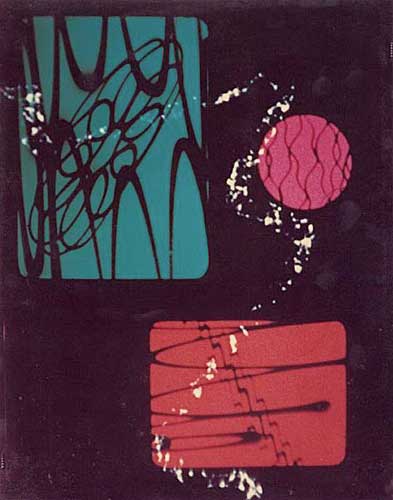
Untitled (Oscilloscope Photograph)
A ca. 1950 oscilloscope photograph by Hy Hirsh — a pioneering figure in visual music and abstract photographic experimentation.
- Medium
- Vintage gelatin silver print from oscilloscope cathode-ray-tube exposure
- Dimensions
- 8"x10"
- Edition
- Unique vintage print
- Provenance
- Available on request
- Price
- $15,500
- Catalog №
- RO-008
A vintage gelatin silver print made ca. 1950 from a cathode ray tube exposure by Hy Hirsh (1911-1961), one of the small group of American artists working with electronic imaging at the opening of the decade in which abstract computer art would take its first form. The work predates Hirsh's own oscilloscope-based film Divertissement Rococo (1951), generally cited as among the earliest motion pictures to employ filmed oscilloscope patterns, and is contemporary with Ben F. Laposky's first Oscillons of the early 1950s, the photographs of cathode ray traces that Laposky published in 1952 in Scripta Mathematica and exhibited in 1953 at the Sanford Museum in Cherokee, Iowa as Electronic Abstractions. Mary Ellen Bute's Abstronic, the third pillar of this triumvirate of early 1950s American oscilloscope abstraction, followed in 1952.
Hirsh came to the cathode ray tube from image-making. He worked at Columbia Studios as cameraman and still photographer from 1930 to 1936, photographed for the WPA, and served as official photographer of the M. H. de Young Memorial Museum and the California Palace of the Legion of Honor from 1937 to 1954. In the late 1940s and early 1950s he became the technical resource for the San Francisco abstract film community, collaborating with Sidney Peterson on The Cage (1947), Horror Dream (1947), Clinic of Stumble (1948), and The Lead Shoes (1949), and building a homemade optical printer that gave technical support to Jordan Belson, Harry Smith, and others in the San Francisco scene. His film Gyromorphosis (1954), built around Constant Nieuwenhuys's New Babylon constructions, took an award at the 1958 Brussels Experimental Film Competition. He died in Paris of a heart attack in November 1961.
The literature on Hirsh is held principally by the Center for Visual Music in Los Angeles, which preserves his surviving still photographic materials including color prints and gelatin silver prints. Cindy Keefer's essay "Hy Hirsh Preservation: History and Mystery" appeared in the Kinetica 3 catalogue (Los Angeles, 2001); William Moritz contributed the biographical entry on Hirsh to L'Art du Mouvement 1919-1996 (1996) and treats him in his writings on visual music alongside the Whitney brothers, Belson, and Smith. The San Francisco Museum of Modern Art holds Hirsh photographs in its collection. The Academy Film Archive has undertaken preservation of his films.
Oscilloscope photographs by Hirsh are uncommon, the bulk of the surviving material having gone to institutional archives.