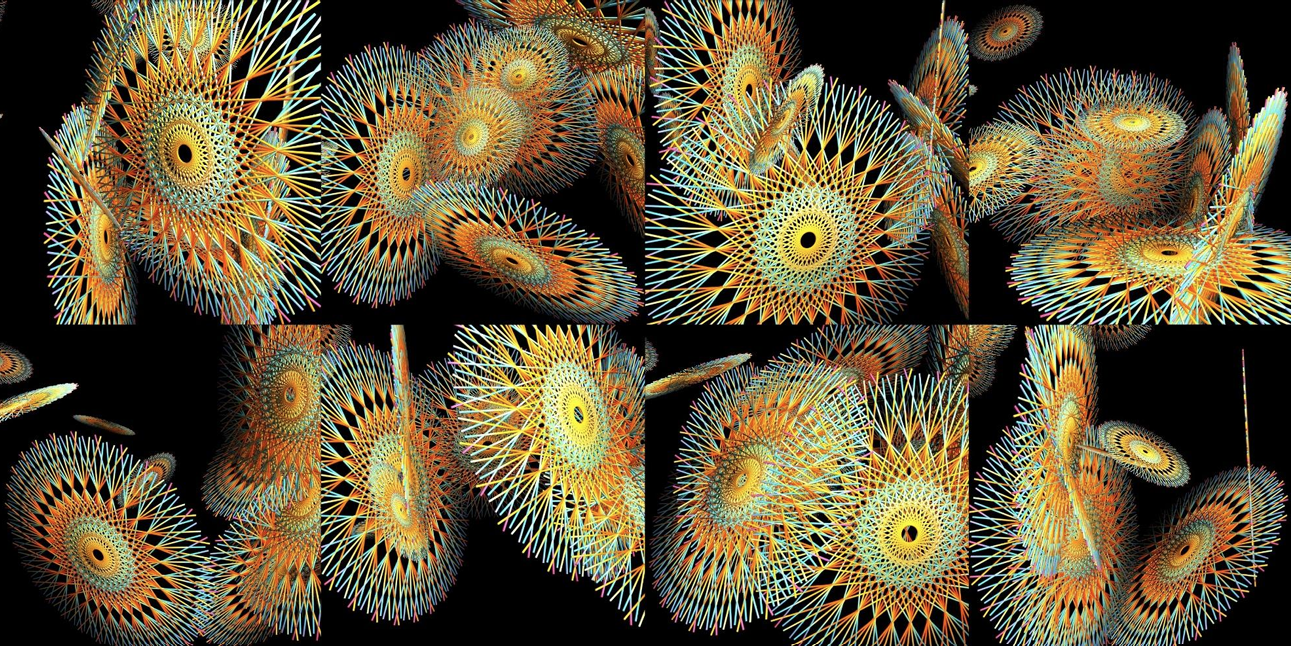
String Weave
A late large-scale work from Charles Csuri's Mosaic Series — sequential frames stitched into a single layered woven composition. Archival ink on canvas, 60 × 84 inches.
- Medium
- Archival ink on canvas
- Dimensions
- 152.4 × 213.36 cm (60 × 84 in.)
- Series
- Mosaic Series
- Edition
- Unique
- Provenance
- From the estate
- Price
- $25,000
- Catalog №
- RO-011
String Weave (2017) belongs to the Mosaic Series that occupied Charles Csuri across the final decade of a career he began at the very start of computer art. Executed in archival ink on canvas at sixty by eighty-four inches, the work assembles sequential algorithmic frames into a stacked, interlaced field of color, the procedural output of a tool Csuri built and refined for himself over half a century at Ohio State.
Csuri (1922-2022) is identified by Smithsonian Magazine as the father of digital art and computer animation. His first programmed pictures were made in 1964; the 1967 film Hummingbird, produced on a microfilm plotter from roughly 30,000 individually programmed frames, was screened in MoMA's 1968 computer-film program tied to The Machine as Seen at the End of the Mechanical Age and entered the permanent collection that same year, becoming the first computer-generated work acquired by MoMA. The same year, Cybernetic Serendipity at the ICA in London placed his plotter drawings before a European public. He went on to found the Computer Graphics Research Group at Ohio State in 1971, the production company Cranston/Csuri Productions in 1981, and the Advanced Computing Center for the Arts and Design (ACCAD) in 1987.
Csuri's plotter output has been canonized, but represents only the opening movement of his practice. From the early 1990s onward he wrote his own 3D drawing and fragmentation software, and from the 2000s he printed the results on canvas at painter's scale. The Mosaic works of the 2010s apply that procedure at large format: hundreds of generated frames are hand-selected and stitched together, producing a textile-like density that resolves into separate small worlds at close range and into one continuous chromatic surface at distance.
Csuri's work is held by the Museum of Modern Art, the Whitney Museum of American Art, and the Victoria and Albert Museum, with additional holdings at Ohio State, where the Charles Csuri Project preserves his archive; he has been exhibited at LACMA and the Jeu de Paume among other institutions. Curatorial attention has placed him at the center of the field's beginnings, exemplified by LACMA's 2023 Coded: Art Enters the Computer Age, 1952-1982, in which his Random War (1967) was a centerpiece. Csuri was not only an artist, but also an All-American and team MVP on Ohio State's 1942 national championship football team and a WWII veteran and recipient of the Bronze Star at the Battle of the Bulge.