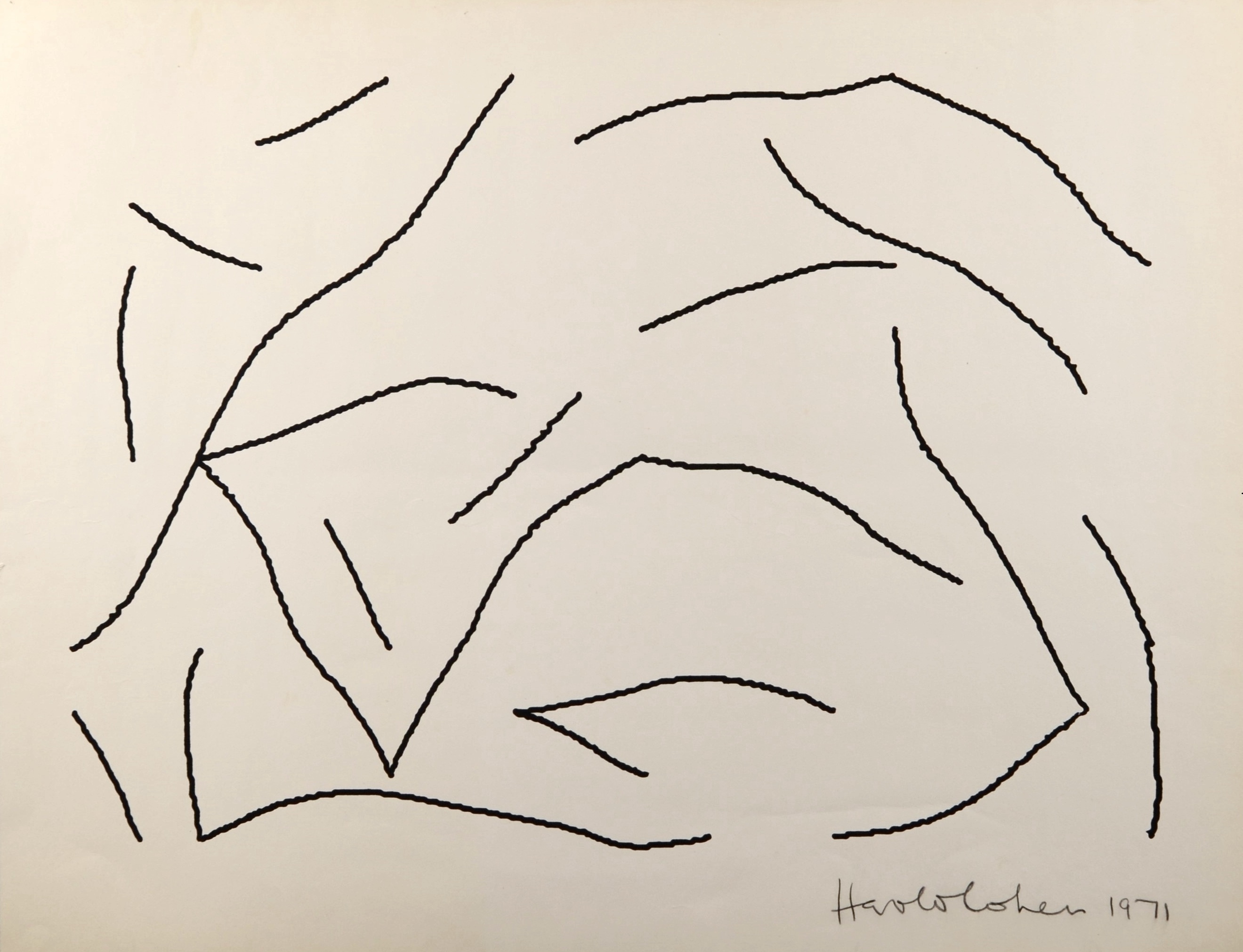
Untitled (1971)
A unique plotter output from Harold Cohen's early explorations with computers and AI — 1971, the year he first presented his computer-controlled drawing machine to the public.
- Medium
- Pen plotter drawing on paper
- Dimensions
- 26"x20"
- Edition
- Unique
- Provenance
- The work was owned by Ken Knowlton and is from his estate
- Price
- $47,500
- Catalog №
- RO-001
A pen plotter drawing by Harold Cohen from 1971, the year Cohen first presented his computer-controlled drawing machine to the public and two years before he would name the program AARON during his residency at the Stanford Artificial Intelligence Laboratory. The sheet comes from the estate of Ken Knowlton (1931-2022), the Bell Labs scientist who created the BEFLIX animation language in 1963 and, with Leon Harmon, the landmark Studies in Perception I in 1966. The survival of this sheet in Knowlton's personal holdings documents the small, mutually-aware circle of figures who were inventing computer art.
Cohen had arrived at this point by an unusual route. Slade-trained (1948-1952), he represented Great Britain at the XXXIII Venice Biennale in 1966 in the "Five Young British Artists" Pavilion alongside his brother Bernard Cohen, Robyn Denny, Richard Smith, and the sculptor Anthony Caro, with a painting practice that placed him among the leading British abstractionists of the decade. In 1968 he took a sabbatical from painting and a visiting appointment in the Visual Arts department at the University of California, San Diego, where Jef Raskin introduced him to the campus CDC 3200 mainframe and he began programming in FORTRAN. The 1971 sheet belongs to the first phase of that conversion, a body of work produced before the program had a name and before the symbolic-rule architecture that would define AARON had fully crystallised.
The 1971 dating places the work at a documented turning point. In November of that year Cohen delivered the paper "A Computer-controlled Drawing Machine" at the Fall Joint Computer Conference in Las Vegas, describing a symbolic system that fed rule-based instructions to a flatbed plotter to produce monochromatic lines that never close. The FJCC presentation led directly to his invitation to Stanford's AI Lab, where AARON was christened in 1973 (see McCorduck, AARON's Code: Meta-Art, Artificial Intelligence and the Work of Harold Cohen, W. H. Freeman, 1991). Works from 1971 are therefore prototypes of the AARON enterprise rather than AARON output.
Cohen's plotter sheets of the early 1970s entered institutional collections and major exhibition venues promptly. LACMA mounted a Cohen exhibition in 1972; subsequent collection holdings include the Tate, London; the Victoria and Albert Museum, which received a substantial gift of computer-art works through Patric Prince in 2008; the Whitney Museum of American Art; the Brooklyn Museum; the Stedelijk Museum, Amsterdam; the Walker Art Center; and the Computer History Museum, Mountain View. Cohen showed at the Stedelijk in 1977, at Documenta 6 in Kassel the same year with the AARON "turtle" drawing live on the gallery floor, at SFMOMA in 1979, and in the 1982-83 touring exhibition that opened at the DeCordova Museum and travelled to the Brooklyn Museum, the Tate, and the Arnolfini in Bristol. The Whitney's 2024 exhibition Harold Cohen: AARON, drawn from the museum's own holdings, returned the program to sustained critical attention amid the generative-AI debates of the present decade.
Plotter sheets securely dated to 1971 are exceptionally scarce on the market. Most surviving Cohen works in private hands are 1980s and 1990s AARON output, by which point the program was producing the figurative jungle and interior scenes for which it is best known; the spare, rule-bound linear vocabulary of the 1971 prototype represents a different and earlier intelligence. Provenance from Knowlton adds documentary weight.