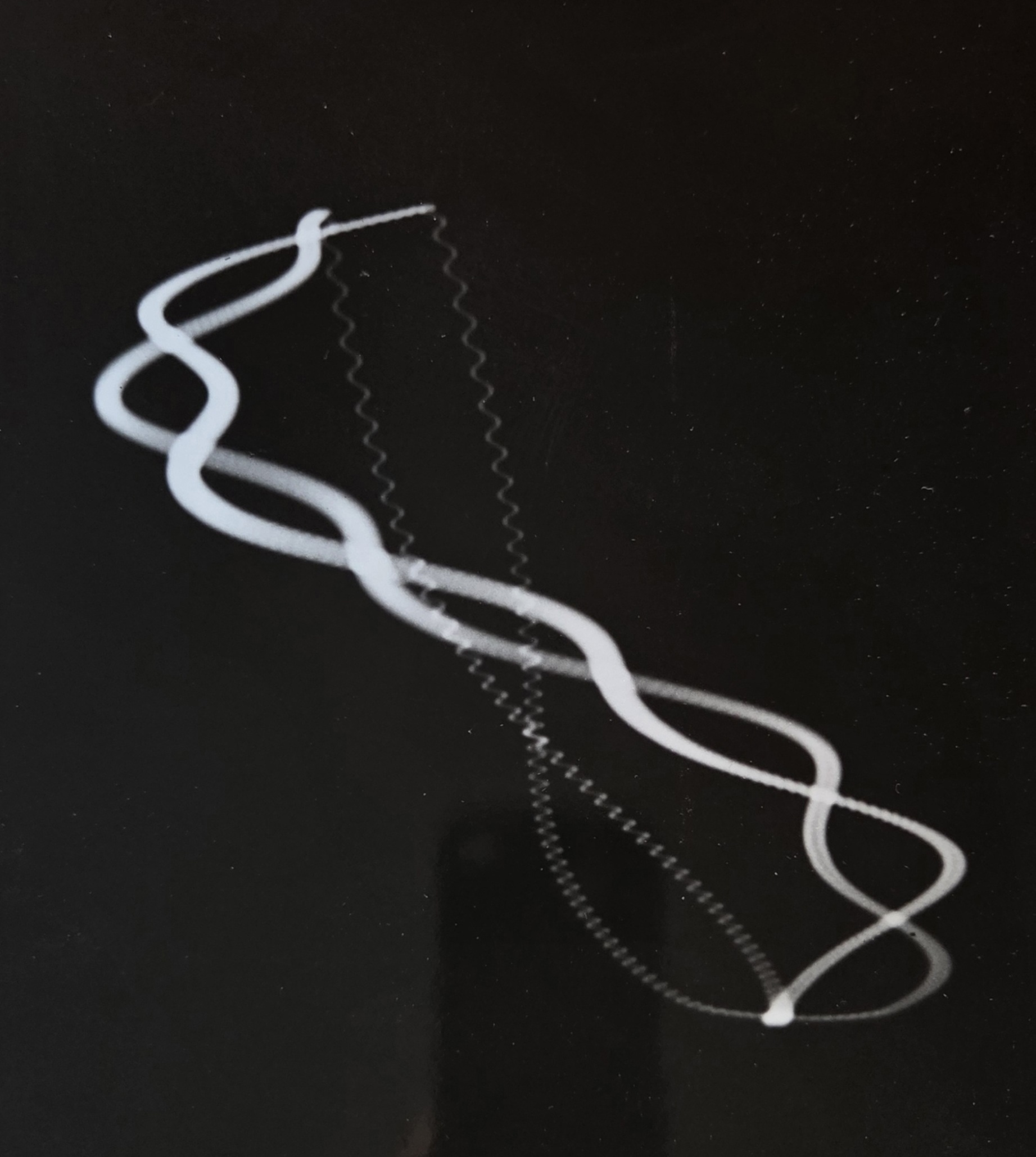
Untitled (Oscilloscope Photograph)
A ca. 1952 oscilloscope photograph from the Mary Ellen Bute archive, bearing the Ted Nemeth Studio stamp verso.
- Medium
- Vintage gelatin silver print from oscilloscope cathode-ray-tube exposure, Ted Nemeth Studio stamp verso
- Dimensions
- 8 × 10 in
- Edition
- Unique vintage print
- Provenance
- Center for Visual Music, Los Angeles; Mary Ellen Bute estate archive
- Price
- $15,500
- Catalog №
- RO-003
A vintage gelatin silver print from Mary Ellen Bute's oscilloscope work in the early 1950s, bearing the Ted Nemeth Studio stamp on the verso. One of the earliest works of computer art. The print dates to circa 1952, the year Bute completed Abstronic, her first film to fully integrate imagery generated on a cathode-ray oscilloscope and one of the earliest works of any kind to bring electronically produced abstraction into the cinema. Photographic objects of this nature, drawn directly from the CRT screen and printed in the Nemeth darkroom in New York, are rare and survive in very small numbers.
Bute (1906 to 1983) trained as a painter, studied stage lighting at Yale, and in the early 1930s collaborated with the Russian musical theorist Joseph Schillinger on visualizations of his mathematical system for synchronizing sound and image. From 1934 onward, in collaboration with cinematographer Ted Nemeth, whom she married in 1940 and whose Manhattan studio became the production base for her films from that year forward, she made fourteen abstract shorts that constituted the principal American contribution to the visual music tradition founded in Europe by Oskar Fischinger and Walter Ruttmann. Her films, among them Rhythm in Light (1934), Tarantella (1940), and Color Rhapsodie (1948), played as preludes to features at Radio City Music Hall and other first-run houses, reaching a popular audience that no other American abstract filmmaker of her generation approached. Tarantella was selected for the National Film Registry in 2010.
For Abstronic, Bute persuaded Bell Labs engineer Ralph Potter to build her an oscilloscope. "By turning knobs and switches on a control board," she wrote, "I can 'draw' with a beam of light with as much freedom as with a brush." Nemeth then photographed the live CRT trace for optical printing with hand-painted color fields and additional animated layers. This places Bute, alongside Ben Laposky in Cherokee, Iowa, whose Oscillons were first exhibited at the Sanford Museum in 1953, and the San Francisco-based cinematographer Hy Hirsh, as one of the three originators of computer art in the early 1950s.
The Museum of Modern Art presented a retrospective tribute to her work on April 4, 1983, and Anthology Film Archives has screened her films; the Center for Visual Music, founded in 2003, has served as a principal archive and distributor of Bute's films and supplied the prints for the 2024 George Eastman Museum exhibition Mary Ellen Bute: Rhythms in Light. The scholarly literature begins with William Moritz's 1996 essay "Mary Ellen Bute: Seeing Sound" in Animation World Magazine and extends through Kit Smyth Basquin's 2020 monograph and Kristian Moen's 2019 study; further context appears in Robin Blaetz's edited volume on women experimental filmmakers.