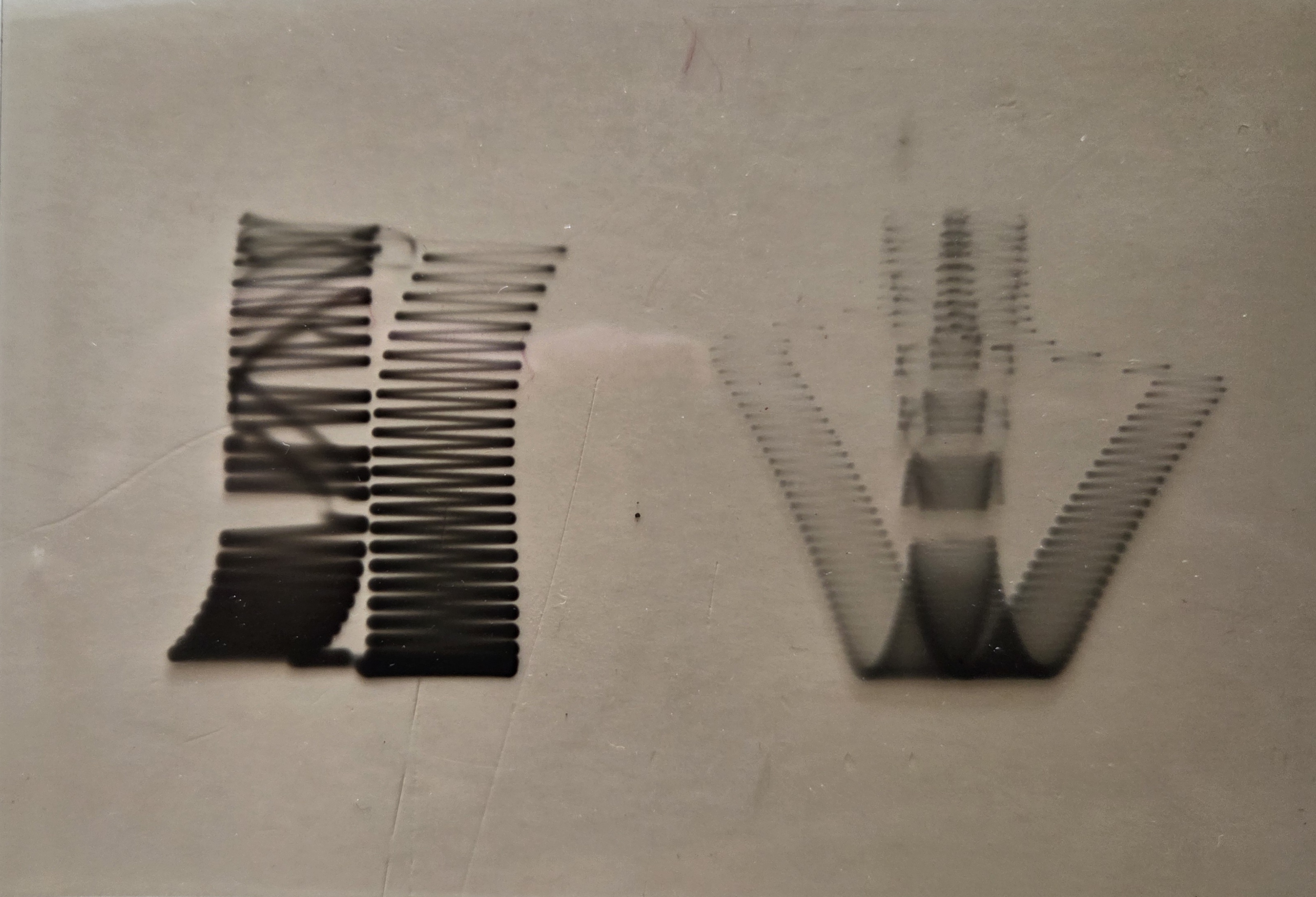
Untitled (Oscilloscope Photographs, two images on one negative)
A ca. 1952 negative from the Bute archive carrying two oscilloscope-photograph exposures on a single frame — an unusual artifact of the artist's working method.
- Medium
- Vintage negative from oscilloscope cathode-ray-tube exposures, two images on a single frame
- Dimensions
- 3.5 × 5 in (8.9 × 12.7 cm)
- Edition
- Unique negative
- Provenance
- Center for Visual Music, Los Angeles; Mary Ellen Bute estate archive
- Price
- $15,500
- Catalog №
- RO-007
A vintage 3.5 x 5 inch negative from Mary Ellen Bute's oscilloscope work, c. 1952, with two cathode-ray-tube exposures captured on a single frame. The piece arrives from the Bute holdings at the Center for Visual Music, Los Angeles.
The date places the work at the exact moment of Bute's transition into electronic image-making. After roughly two decades of hand-animated visual music films set to Bach, Saint-Saëns, Wagner, and Copland, she persuaded the Bell Labs engineer Ralph Potter to build her a custom oscilloscope — an instrument that let her draw directly with a controlled beam of light rather than through thousands of hand-rendered frames. She used it to compose imagery for two films, Abstronic (1952) and Mood Contrasts (1953). Abstronic, scored to Aaron Copland's "Hoe-Down" and Don Gillis's "Ranch House Party," was her first oscilloscope film and is contemporary with this negative. It places Bute alongside Ben F. Laposky, whose Oscillons were photographed off a CRT screen in Cherokee, Iowa beginning in 1950, and Hy Hirsh, who began using electronic imagery in the same window, as the three originators of oscilloscope-based abstract imaging in America.
Bute's films had unusual public reach for experimental work. Abstronic and its predecessors played Radio City Music Hall ahead of Hollywood features. Her films are preserved at the Yale Film Study Center and have screened at Anthology Film Archives, including Rhythm in Light (1934), Synchromy No. 2 (1935), Synchromy No. 4, Spook Sport (1939), Polka Graph (1947), Color Rhapsodie (1948), and Abstronic itself. The Museum of Modern Art screened Passages from Finnegans Wake in 1983, months before her death; her papers, scripts, and correspondence are held at Yale's Beinecke Library, alongside the Cecile Starr Papers Relating to Mary Ellen Bute, the research files of her longtime distributor and champion.
Working negatives from Bute's oscilloscope period rarely reach the market. The negatives have remained with the archive and reflect the physical contact between Bute, her Potter-designed instrument, and the emulsion. The two-image frame is, in some sense, more intimate than a print.